
When being clear may instead dull the light on the hill
I was thinking about the value of a "light on the hill" to guide a complex project, and it reminded me of a great story a colleague told me about her project and the value of keeping it a bit "fuzzy".
She had a complex issue around evaluating a major environmental plan, and the group found some challenges when trying to set the direction. Given their interest in evaluation, they found themselves naturally gravitating towards seeing success as something like 'a set of measures or KPI's'.
However they were following a collaborative guideline at the time that asked them how they would know they had succeeded, and so they took some time to re-consider what they were aiming for.
After some discussion and consideration, they agreed on a set of success factors that were quite broad eg good environmental outcomes, confidence that the actions were delivering, etc, but still provided sufficient guidance to know they were on the right track (which is all you can really do when faced with complexity where even the problem is unclear, let alone the solution.)
However what the exercise did reveal was the risk that they were running by unconsciously narrowing their vision to an objective like a 'set of measures or KPI's'. They recognised that staying with such narrow objectives may have trapped them in a business as usual approach that would constrain the potential solutions, and restrict the innovative ideas that might be possible.
As it turned out, the real value of the broader and less distinct "light on the hill" only became apparent later, with a realisation that the really innovative outcome emerging from the work was the ongoing development of an "evaluative mindset" with those involved in the project, and those who were also drawn in to the work. While measures and KPI's did also feature as elements of the emerging solutions, the real value was the change in thinking as more people saw their role in evaluating success of their interventions.
So in this case, living with a fuzzy goal contributed to smarter solutions.

A Parent's Guide to Complexity
So there we were last night, finally in bed with reading in hand when my wife put her book down, paused thoughtfully for a moment before saying “the boys seem happy at the moment”.
And it’s true. They do. They seem happy, increasingly resilient, even a little more confident in themselves. Beat the drums and sound the trumpets! Which parent of teenage boys doesn’t want to be able to utter those words from time to time. Of course we want these things for our boys, but there seems to be a problem. We don’t really know how to deliver them.
We feed them: check
Clothe them: check
House them: check
Slip them some spending money from time to time against our better judgement: check
Drive them to parties and pick them up in the wee small hours: check
Provide access 24/7 to endless Netflix and computer games: check
Educate them and give them a range of experiences to draw on: check
Yet despite this, there have been times when each of them has been deeply unhappy, even intractably so. How can that be when we are so obviously ticking the teenage boy happiness checklist?
Raising boys is complex. (Raising girls they say is even more so God forbid). So this of course means that we poor parents are sentenced to long years of uncertainty, worry, intermittent feelings of failure and an abiding sense that ‘we must be doing this wrong’.
Those feelings are understandable and probably unavoidable. After all, they come with the territory of complexity. Yet I take comfort from this idea of creating confident, happy boys, comfortable in their own skin and ‘well-rounded’. We may not know what it’s going to take to get them there but we know that this is what we are working towards. Sometimes, as last night, it seems to be quite close. Other times it seems unattainably distant.
The point is of course that we are aiming for something. Our loosely-defined destination guides us every day as we learn this parenting thing. While we can never be sure how to get there, the idea is like a light on a distant hill inspiring us to act and learn together, even when we are most unsure.
So if you are facing something complex, whether raising a family or delivering something at work, identifying your light on the hill and keeping it in sight can help you navigate the uncertainty.
Now can I go back to reading my book?

Experimenting with a new thought....... by Bridget Marsh
As a coach my role is to help people think differently so they can behave differently....... so I started to think about what makes it difficult for people to think differently.
One of the possible causes is how we are taught in school. In school there is usually a correct answer and we are rewarded for knowing it. We are seldom rewarded for questioning ... anything, particularly authority. Is it any wonder that in work we find this hard.
I'm not sure why I always found it difficult not to question, however I did. So maybe I've always been challenged by the idea that there is a right way to do things.
In my working life I also challenged the 'right' way to do things.
When I was Head of School at Unitec School of Performing Arts we wanted to create a degree that was different, that would give us a significant point of difference. I suggested a number of quite radical ideas including offering a degree where all the streams of acting, dance, choreography, directing, writing were taught together. This was certainly a novel idea and took some time for my team to accept.
I also suggested that we could challenge the usual way of assessing students.
At first this was rejected but eventually my team chose to do it on their actual performing skills... not what they could write about acting and dancing.
What that experience highlighted for me was that even people who are normally creative in their work seemed unwilling to question or experiment with different ways of doing things.
I feel it is natural to question why things are done in one way and not another. So it also seems natural to me to question others on their thinking. But it doesn't make it easy for them to necessarily think differently.
To think differently starts with a desire for a different end result. What we are currently doing isn't getting us the results we are looking for. And a willingness to accept that we could be wrong....maybe not wrong, rather just not succeeding in the way we want to succeed.
So I get clients to experiment.....try a new thought. Like trying on new ideas they need to see how it feels and imagine how they might behave with that new thought. It doesn't change behaviour immediately because, depending on how long we have been thinking in the old way, we quickly revert to old behaviours. However slowly over time we can change our behaviour. And by behaving differently we get new results. The next step is to ask if these new results take us closer to the end result we are looking for or further away. If it takes us closer then we can do more of the change. And so it goes.....one thought at a time.
Click here to read our latest newsletter
or visit https://twyfords.com.au/
by Bridget Marsh- Twyfords NZ Associate
Just try stuff…. (or let’s call it experimentation)
One of the best explanations I’ve heard of how to work in a complex environment was from a client last year when I asked her how she now approached her project.
She said that rather than trying to plan out the answer (which was her previous approach), she said she just tries something, checks to see if it is getting her closer to a useful result, and then either does more of that if it seems to be helping, or tries something else if it isn’t.
I was struck by the simplicity of her explanation, and find it a very useful way to describe an appropriate response to the demand for action that is ever present when tackling a difficult to solve dilemma.
I reflected on how we have learnt the value of “experimentation” with a recent issue facing us internally. We were reviewing our marketing approach and were frustrated by a lack of traction with our messaging with potential clients about what we do.
So while our past tendency and experience was to be sure an alternative strategy was robust and would guarantee success, we recognised that we are facing a complex dilemma where cause and effect are not obvious, and probably unknowable, and so perhaps we could just try something different without risking the our whole approach, and see what effect it might have.
We had some reluctance and anxiety in trying that, given the uncertainty and risks inherent in not knowing what might happen (heaven forbid- we might turn off potential clients or push them away!)
So we decided to try something different- a significant change to our messaging.
But we also added some discipline-
- checking that we had an overall outcome in mind (a “light on the hill” reflecting our sales goals)
- making the change manageable – keeping it “safe to fail” where we feel we can manage the risk
- Making the changes quickly and over a short time period (so we can evaluate quickly)
- And identifying what evidence and outcomes we needed to see over that period to either keep promoting the change, or for us to try something different
This experiment is still a work in progress, but it just feels like the right way to go when we are facing a complex issue. We know from bitter experience that being certain about the way forward has led to disappointment and frustration, and we are increasingly confident that just trying stuff makes more sense.
Is Best Practice Water Management a Myth?
Managing urban water challenges lies at the heart of a sustainable future and drives my work in the sector. As a coach, I talk to many managers and leaders grappling with difficult water projects, learning from both their successes and their failures. In my blog of November 2018, I shared some of the things I’ve learned about mindsets to enable great collaboration. In this blog I will explore one specific element of mindset for water managers.
The mindset I strike often is the idea that we must apply ‘best practice’ to our projects. But this can be a trap for us all. I have learned that when facing complex, multi-party water challenges, the myth of ‘best practice’ can limit, rather than support, progress.
What do I mean? There are many urban water and sanitation initiatives around the world, and from these are emerging many models and frameworks for how to achieve water outcomes. A good example is Sanitation 21, published by the IWA and partners in 2014. This document lays out a comprehensive, detailed ‘map’ for improving sanitation in the developing world. It includes process flow charts and step-by-step instructions and is explicitly an attempt to reflect best practice.
Its great strength is its careful detail about how to go about sanitation projects. Yet, I believe that without a collaborative mindset, this detail can also be a great weakness.
If you are building a water treatment facility, you will find a best-practice, step-by-step guide very useful. You know what the problem is. You know what the endpoint will look like. And if the construction plans have already been proven, they should work just as well here. But changing the long-term sanitation practices of a community is a qualitatively different type of problem. In this situation, there are multiple variables, only some of which we can be aware of and lots of players with different drivers and concerns. There are unique geologies, geographies, governance practices, climatic conditions, budgets and habits. There are social interactions and practices that we can’t possible understand completely. In short, every project is unique and what worked last time may not be appropriate here. In this context, if we attempt to rigidly apply our ‘best practice’ approach we are very likely to fall short.
A key weakness of the best practice myth is that by focussing on delivering a program we greatly increase the likelihood that we are doing this program ‘to’ the people we most need to work ‘with’. This is where mindset comes in. If I feel I have a clear, smart process to follow then my task is to apply it to the best of my ability. But if my belief is that my process map is a hypothesis I bring to the table, rather than the best practice answer, I will think and act differently. I will see stakeholders as co-designers of process. I will listen as loudly as I speak. I will be prepared to put my process back in my pocket and experiment together with this community.
Doing so will encourage innovation from the very people who are impacted by the problem in the first place, whereas doing my change process to them will likely drive them away.
But giving up my process is hard. Sharing control and taking risks makes me feel vulnerable. Isn’t it easier to stick to a proven pathway?
Easier, yes. But that is the trap of the best practice mindset.
Want to read more about how to successfully deliver complex projects and avoid the trap of best practice?
Simple Habits for Complex Times: Powerful Practices for Leaders 1st Edition
Jennifer Garvey Berger, Keith Johnston
Stanford University Press 2015
A leader’s Framework for Decision Making
David J Snowden and Mary E Boone
Harvard Business Review Nov. 2007
The Power of Co: The smart leaders’ guide to collaborative governance
Vivien Twyford et al
Twyfords 2012
https://extranewsfeed.com/making-sense-of-complexity-ee78755d56b9
Note this article was first published by the International Water Association

The Hard Truth at the Heart of Collaboration
I’ve spent a lot of time over the holidays thinking about the connection between the ability to collaborate effectively and the ability to be vulnerable, and I'm beginning to see a hard truth.
Stuart in his blog last week, used Ken Henry, until recently Chairman of the Board of the National Australia Bank, and his performance at the banking Royal Commission, as a typical example of our desire to minimise our vulnerability when challenged. Stuart pointed out that, by “hiding his humanity, by denying to us any sense of shame or remorse or sorrow” when being grilled by Counsel Assisting, Ken Henry broke the bonds of respect and trust.
I have some sympathy for Mr Henry. I personally feel particularly vulnerable in situations when people either have high expectations of me and my performance or are looking to me for answers to challenging questions in my field of expertise. When I dig down, I think my vulnerability comes from underlying imposter anxiety when in front of people who will judge me: “I’m not good enough to do this well; people will see me for what I really am; I’m only posing as an expert! I don’t have anything original to say!” I feel this particularly when I have to make an argument from behind a podium.
The problem with this very uncomfortable feeling of vulnerability is that it shows. The more discomfort I feel, the greater the effect on my performance. If I continue to show myself as an expert who must behave ‘expertly’ to meet expectations, I hide who I really am. I’m no longer the person who is curious, empathetic and who enjoys engaging with others; who uses conversations as a vehicle for sharing ideas and co-creating a future together.
Brene Brown, the researcher, speaker and author who has had much to say about vulnerability, believes firstly that being able to show vulnerability is a strength and not a weakness, and secondly that our fear of being unworthy or of being flawed is the secret killer of innovation. This fear stops us speaking up, sharing ideas, thinking differently, exposing ourselves warts and all. We are afraid we’ll be seen as wrong or misguided and therefore we’ll be open to being judged, belittled or laughed at, or at worst we’ll be criticised, demoted, demonised or passed over in our careers. It takes strength to overcome those fears.
And that ability to sit with vulnerability is the hard truth at the heart of collaboration.
If we behave as experts and focus only on what we know, we won’t learn from others, and others won’t share their innermost thoughts easily with us. Collaboration needs us to learn about the problem from all perspectives and learn about complexity itself. Collaboration is listening and acknowledging the strengths and contributions of all collaborators. Collaboration is being comfortable to say, “I don’t know, I need your help”. Collaboration is experimenting without knowing the answer.
So, what can we learn from this?
The key is accepting that vulnerability is a strength and not trying so hard to avoid it.
In our coaching we encourage clients to be curious about those underlying feelings that make them feel uncomfortable. We help them to recognise that defeat, failure and disappointment happen to everyone at some time and do not equate to unworthiness or being less than. We reassure them when they fail, are disappointed or miss out, that they can learn from their experiences. We support them as they grow and move on and become wiser and better equipped in their work with others.
Are you ready to face collaboration's hard truth and build your capability to be vulnerable when you work with others?

Bankers and the Path of Vulnerability
In Australia we have just been through a very revealing Royal Commission into the Banking and Financial Services sector. For most of us the nightly news updates from the hearings have made compelling viewing. For the bankers called as witnesses it has been much more traumatic.
During the many months of the Inquiry, senior banking staff were grilled before wrapt audiences. When confronted with evidence of their own, or their banks’, misbehaviour, witnesses tended to wilt before slinking away with tails firmly between legs. But there was one notable exception; Ken henry, Chairman of the Board of the National Australia Bank (NAB).
Mr Henry, a very senior and respected ex-public servant, stood apart from other witnesses. He came out fighting. He was solid in defence, haughty and unrepentant, with little or no acknowledgement of wrongdoing. Was he a shade dismissive?
Last week the Commissioner – gimlet-eyed Kenneth Haynes – handed down his final report and within days Mr Henry and his NAB CEO had resigned their posts, tails between legs after all.
To me, the story of Ken Henry and the Commission is a story about vulnerability and our powerful desire to minimise it. When he appeared before the Commissioner late last year, Mr Henry had his full suit of armour on. Despite the fierce attacks of Counsel Assisting, he deflected all blows and kept himself safe from harm. With his success did he ensure his ultimate failure?
While wearing his armour, Ken Henry the person was invisible to us. With his well-defended mindset he was in effect prioritising his own safety and self-image over his relationship with the rest of us. By hiding his humanity, by denying any sense of remorse or sorrow, he broke the bonds of respect, trust and empathy. How can we understand and empathise with someone who hides behind armour plate?
The very real human instinct to keep oneself safe often gets in the way of our attempts to work with others. We want to collaborate. We believe we are collaborating, yet our unwillingness to reveal our own weaknesses or insecurities in those relationships undermines the very relationships we need in order to work together effectively. We all face moments of truth when we can choose either our own sense of safety and ‘rightness’ or the health and wellbeing of our collaboration. It is hard not to choose the former, but if we are genuine about collaborating, the path of vulnerability is the path we must take.
Manual focus on collaborative capability
I read an article last year by Dominik Vanyi about slow photography - how he found his brain effectively "rewired" by changing a long established practice- in this case from using auto focus and moving to manual focus for his commercial photography.
It struck me that it has a lot of similarities with my experience in building capability around collaboration- the less you intervene and the slower you go, the more learning happens and the minds seem to rewire more quickly.
In the article, Dominic relates that the significant learning for him was how manually focusing his camera made him slow down- to compose pictures more thoughtfully and putting more thought into how he approached each photographic opportunity.
This parallels our experience with working together- the act of stopping and reflecting- slowing the "campaign rush" - can be more useful and more valuable than all the quick interventions in the world.
A client recently related to me how they now take a more thoughtful and intentional approach to each team meeting- rather than jumping straight into content they first slow the group and ask some reflection questions before diving into the topics. She noted that it created space to be more collaborative.
Dominic's other insight was that focusing by hand had rewired his photographic brain- and how it was not easy but required ongoing practice.
Similarly we see that changing habits of a lifetime around working with others takes time and practice to become automatic and authentic. Another client related that they can no longer tolerate the business as usual behaviours of some colleagues as their rewired brain sees better practice, so they now intervene to support new ways of working that get more effective outcomes.
So how can you get your manual lens?

A Dangerous Idea- Love your Enemy!
I watched a TV news item recently where Govt bureaucrats were engaging with farmers on the Darling River about water allocation. It looked a bit confrontational and unsatisfactory, with several seemingly intractable positions.
I was reminded of this yesterday at the Festival of Dangerous ideas, in Megan Phelp's-Roper's conversation ("Love your Enemy") about how kindness and conversation had a transformational impact on her life.
I was struck by her comment on the really dangerous ideas in our civil discourse- things like blinding certainty and dogma, and wondered how useful her insights might be in the challenges of attempting collaborative conversations with "difficult people" around some of the major water challenges like the Murray Darling Basin.
Briefly Megan's story focuses on how she shifted from an entrenched religious position to leaving her church and now advocating for change in how people engage- from zealotry to an anti extremism educator- see her TED talk here
While I'm not advocating that we need such extreme conversion in the situations facing water planners, it did seem that a lot of the same elements Megan faced are evident in our conversations internally and externally as we face difficult and complex situations, particularly when positions are a bit entrenched:
- knowing and certainty
- being right
- telling not asking
- fear of others views
- one view
- blaming others
and seemed to me that some of what Megan experienced in her transformation can give us great clues about different ways of behaving when we face those "difficult" people:
- learn my story, understand theirs
- listening is not agreeing
- assume good intent
- disagree without demonising
- show empathy and kindness
- be generous and show gratitude
- it's OK to take in new ideas and maybe change your mind
In the twitter conversations that helped shift Megan, she noticed others using four small but powerful steps that made real conversation possible:
- don't assume bad intent- they believe it
- ask questions- hear them
- be patient- pause, breath, then come back later
- make the argument- if we want change, we must make the case for it
Perhaps a bit of love is not such a dangerous idea.
Wine, Castles and Complexity
I’ve just returned from a few weeks’ leave in Europe, including the beautiful Alsace region of France. And while I thought I was driving the route de vin for fun, it turns out I was learning something about complexity too.
The Alsace has long been a strategic cross-roads and has been claimed by both Germany and France at different times. It is a famous wine growing area, with the foothills of the Vosges Mountains draped in vines around beautiful, ancient towns.
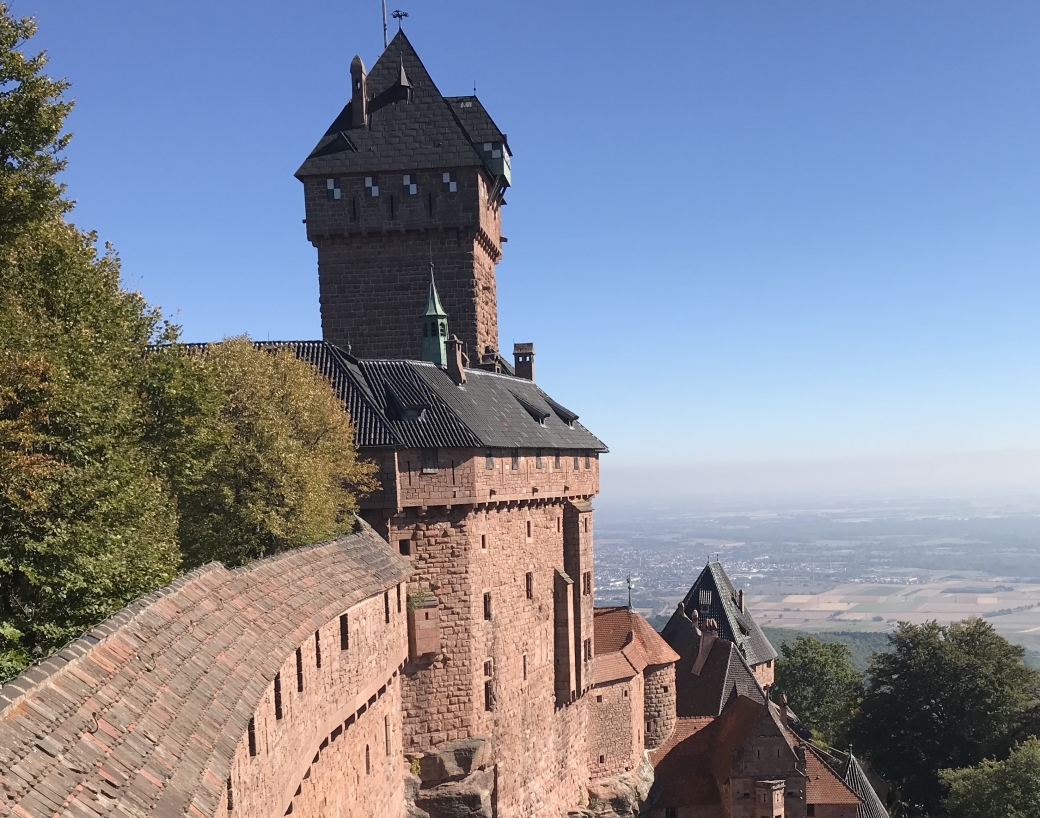
High above the vines sit many famous castles and forts, built to safeguard the townships and trade routes below. And this is the thing that has been on my mind. While the townships continue to thrive, the castles high above are for the most part in ruins. And I can’t help but see this fact through the lens of complexity.
Here is my naïve and un-testable hypothesis. Towns arise more-or-less organically as people find ways to make life work together in a complex world. As times change lifestyles change too in an endless process of reinvention and emergence. Nobody is in charge and everyone is a decision-maker in their own small ways.
Consequently, the towns are still here and look likely to be here for another 1000 years.
But what of the castles? Unlike townships, castles don’t arise organically. They are planned, designed and built as a specific solution to a specific problem. They work while they work, but because castles exist in a complex World, that clever, fixed solution inevitably becomes a problem in its own right. Eventually, the castle is abandoned and the world moves on.
So to my questions from the Route de Vins: are towns a good example of how to make progress in the face of complexity? And do castles represent the risks of treating a complex problem as though we can solve it with a single ‘smart’ solution? One survives while the other is in ruins. Which brings me to my final question: In your organisation, are you building a castle because you ‘know’ the problem and ‘know’ the answer, or are you encouraging a town to emerge because you realise that emergence and constant innovation is essential?
I recommend the Alsace for further research….