
Exhausting Lessons in Communicating Across Barriers
As my wife will attest, I’m not a French speaker, but I do have a (very) basic vocabulary. This means that communicating when in France can be quite challenging, sometimes embarrassing, often hilarious. It struck me that my struggles to communicate in a foreign language are a little like the struggle to communicate with those who think differently to us in everyday life.
For example, I have a client in the stakeholder engagement team of a large utility. Their communication struggle tends to be with the internal infrastructure team who design and build the pipes, who come from a different background and see things through a different lens. Sometimes the teams feel like they are speaking different languages.
So what can a month in France teach me about that challenge? Well, despite my limited French I did manage to communicate using:
- Multiple channels, sometimes writing things down, even using facial expression and hand gestures to get my meaning across.
- I listened as loudly as I spoke. I concentrated very hard on what was being said to me and invested a lot of energy in clarifying meaning.
- Most importantly perhaps, I was highly motivated to communicate, as only being stranded on a rail platform in a foreign land can motivate a person. I wanted to understand and to be understood. I cared deeply about what was being said to me.
For my client this means trying diverse channels to deliver and receive messages to and from the engineers. It means really listening. Asking rather than telling. Being curious and wanting to know how ‘they’ see it.
Communicating in a foreign language is an enjoyable challenge, but it can be completely exhausting, which probably indicates how much I was investing in trying to communicate. I know that working with collaborators can be exhausting too, but perhaps that’s an indication of your commitment to working authentically with others. Working across barriers is tiring, but worth it.
The photo is of Estaing, one of the many beautiful villages we walked through on the Way of Saint James.


Whose Story Is It Anyway?
Over the years I’ve had a number of experiences that left a lasting impression on me, supercharging my belief in the value of doing ‘with’, not doing ‘to’. One such experience taught me that it really matters whose story is being told and who is telling it.
In this instance I was contacted by a local Council, asking me to facilitate a couple of public meetings to discuss Council’s proposed rate rise. The two meetings had already been scheduled and advertised. They were expecting a pretty negative reaction from ratepayers and were looking for someone to “manage the room”.
It was a pretty constrained and uninspiring brief, but in the few days prior to the first meeting I hatched a plan that, I hoped, might make the process more meaningful and useful to all.
The first public meeting arrived. I did my best to ensure Council made its case clearly and that ratepayers were heard. Council told their story of budget pressures and the need to repair things such as roads and bridges. After everyone had been heard I asked everyone to indicate their level of support for the rate rise, by placing a sticky note on a ‘spectrum’ from very low to very high. As expected, people on the whole didn’t want to pay higher rates. No surprises there.
Then before closing the meeting I called for some volunteers for a working group that would meet the following week with Council to dig deeper into the rates issue. We left the meeting with a dozen or so volunteers, many of whom were quite actively opposed to rate rises.
On the appointed day the group convened at Council and began a day of sharing, listening, questioning and learning. The day included a bus tour around the city to see first-hand the problems with existing infrastructure. The netball courts were unsafe. Rusty guardrails on the mountain road were no longer fit for purpose. The century-old wooden bridges were desperately in need of replacement. Stormwater drains needed work.
Working group members came back from that trip saying things like “I didn’t realise how bad the mountain road is” or “I had no idea it was so expensive to replace a drainage culvert”. At the same timer, Council staff heard stories about hardships among the community and the surprising expenses that small businesses faced.
The next evening we all went back for the second public meeting. This was another large event, open to all community members. This time, members of the working group were invited to share their experience and what they had learned. While much of the detail was the same as Council had already presented, these community members were telling their story. They spoke about their roads and bridges, and their kids who need safe sporting fields.
Was it received differently to Council’s story? Definitely. The final act of the process was to once again ask everyone at the meeting to indicate their level of support for the proposed rate rise on the same spectrum of support. And wouldn’t you know it? This time around, the majority was in favour.
When stakeholders get their fingerprints on a process, when they are extended the respect required to learn together, they are able to write their own story about the dilemma, rather than accept someone else’s. And this story carries a different power.
Whether you are the CEO of a Council, a Health Care organisation providing services to clients, or a manager with a team to work with, inviting your stakeholders to write their own version of the story can be an essential component of success.

Oscar Winners, Net Zero and the Skills Gap
Everything, everywhere, all at once is a great title for an Oscar-winning movie but according to one commentator it’s also the essential approach for progress towards a low carbon future.
I recently attended a thought-provoking panel session hosted by the Institute for Sustainable Futures (my alma mater as it happens), where global specialists on transition planning and implementation talked about the road ahead. It was more than a throwaway line from a panellist that everything, everywhere, all at once is what we need to be doing. Reaching net zero is hard and requires all hands to the pumps.
We heard that what is required is a “global collaborative effort to scale up” the transition across all sectors and all countries. That got my attention, along with the ensuing discussion about the economy-wide shortage of skills necessary for helping companies transition to low carbon operations.
What are the skills of doing everything, everywhere, all at once to meet our Paris commitments? Obviously there are a lot of technical skills required, such as scenario planners, financiers, electricians and a thousand others. Yet I believe there is a less obvious capability that will be needed and that is the suite of skills required to work across business-as-usual boundaries to make the systemic changes needed. These include:
Systems thinking as we grapple with whole supply chains and circular economies to find smarter ways to do more with less.
Experimental mindsets we will need in order to try things that just might work (and just might not), and to learn as we go.
Relationship building, essential to making the connections across networks of stakeholders, even where we are in competition for resources, market share, scarce dollars and scarcer people.
Customer, community and stakeholder engagement required as we bring the whole system into the room (figuratively and even literally) to co-create new ways of doing business.
To do everything, everywhere, all at once we will need an awful lot of collaborators, which raises some questions: Where are companies going to find people with these skills, and where are people going to learn those skills? Where are you going to look?
I'm making my own small contribution to closing the skills gap in April, with a short workshop on the core collaborative skill of co-defining the dilemma. Check it out and book .

Is there something other than 'othering'
The big news in Australia this past week has been all about AUKUS, the agreement between Australia, the UK and the US, at the core of which is the plan for Australia to acquire nuclear submarines.
All the talk of “us versus them” around this announcement got me reflecting again on our human talent for tribalism. I can’t help observing that there is a whole lot of ‘othering’ going on out there. No doubt I’m guilty of it myself. My question is, can anyone point to a single example where positive and constructive outcomes have arisen from othering, from highlighting differences and perceived negative traits of the other group, of defining ourselves as ‘not them’? Is there one single example from anywhere? Ever?
Surely we can find a constructive way to deal with our ancient animal urge to represent them over there as bad or threatening and us over here as good or under threat from them?
This doesn’t mean we should be naïve or wilfully blind. Rather, I think it asks us to be wilfully curious, stubbornly open minded and doggedly open hearted about the motivations and interests of other people. Perhaps even to have our ways challenged and shown to be imperfect, even as ‘their’ imperfections seem so apparent to us.
My work on a daily basis is about supporting diverse people to come together around challenging and sometimes controversial problems. It would be impossible to make progress if we focussed on differences and continued to expect ‘them’ to behave badly. Rather, success comes when people choose to listen to each other and recognise that nobody holds the ‘truth’ in its entirety; when they walk together in mutual uncertainty and collective willingness to find a way together.
The world is a challenging and sometimes dangerous place and perhaps there is a need for more submarines. But for sure we could use more investment in building bridges between peoples. Bridges sometimes do fall, but doesn’t history show us that ‘othering’ is a road to nowhere?

Diving in to a collaboration mystery
“It has been great just to spend time on this together. We so rarely come together like this.”
“I was pretty sceptical walking in but having been a part of this workshop over the past few days I feel quite positive. It has been a very useful.”
When I hear comments like these from participants in workshops I’ve been facilitating I find it gratifying of course. But I also find it a little frustrating. My automatic thought is “if it’s so useful, why don’t you do this more often?”
I can’t remember when participants last found that the time spent working together in the room wasn’t useful. So it has always puzzled me that workshops with diverse people from across the organisational system aren’t a regular thing. I know I am biased but they feel so self-evidently productive from where I sit.
The quotes above are both from senior leaders in state government at the completion of a set of workshops I recently ran. Over three days this group tackled the task of creating a high-level plan for a new bit of complex policy. It is challenging work involving some quite challenging concepts and practices, yet after three days they felt they had made excellent progress.
So why aren’t workshops among senior people more of a thing?
I put this question to the project team, who had so ably helped to design and facilitate the sessions (big shout out to them). Their blunt reply was that “most workshops are pretty crappy”.
At which point it all made sense. Why would busy leaders want to come together for those terrible ‘talkfests’ we keep seeing? In their shoes I would run a mile too. Yet the opportunity cost of not coming together regularly seems very high, when I consider how productive diverse groups can be. Not only do they foster new ideas but they build shared understanding and much greater ownership of and commitment to the outputs. Doesn’t every leader want that?
The message seems clear. Nobody wants to waste time in a talkfest, and poorly-managed meetings have given all workshopping a bad name. But a thoughtfully designed and facilitated ‘workfest’ is a different beast. While I understand the impulse to avoid poor meetings, a great workshop always adds value.
At least I now know why workshops aren’t more common; People are understandably scared of wasting their time. So my next question is how can organisations best avoid poor meetings and boring talkfests while finding ways to do productive work together?
Hmmm…that’s a good topic for a workshop…..
The image is of a game of Underwater Hockey, a great sport that was a big part of my life at one time. If you haven't played it, go and check it out where you live. Like all team sports it involves lots of collaboration, and successful teams are more than the sum of their parts. photo credit Caleb Ming for ESPN

The Diamond Ring of Decision-making
Complex problems require a different approach.
In my I wrote about Sam Kaner’s Diamond of Participatory Decision-Making, which has always helped me think about what authentic collaboration feels like. It can be hard work.
The diamond shows us that after some ‘groaning’ we get to a point where we can converge on an outcome or outcomes, which has always been very encouraging. Yet I also know that when confronting our more complex and intractable problems the reality is that we rarely get to ‘the answer’.
For example, improving water quality and management at a catchment level is one of those ‘forever’ problems that never really go away. Catchments and all that goes on within them are an ever-evolving suite of dilemmas, dynamics, pressures and responses. We can always improve what we do, but the problems are never ‘solved’.
So what does this mean for the diamond of participatory decision-making? As a map for visualising how we tackle complex problems, perhaps the diamond is actually a circle. Rather than getting to the end, we continuously cycle back, through periods when our thinking is diverging and periods when our thinking is converging.
I have tried to illustrate this idea here.

I see this journey as a cycle of learning. In a way we never leave Kaner’s ‘groan zone’. Rather we recognise that when dealing with hard problems we are always sitting with uncertainty, incomplete knowledge, unintended consequences, different worldviews and different ideas. While outcomes are always important, our overarching approach is not about finding ‘the answer’ but about constantly finding new questions to ask and new ways to test our understanding and our ideas. Dave Snowden of fame suggests we “probe, sense and respond” in the complex domain. That is, we test ideas. When we find things that seem to work, we do more, building on success while always watching for signs that this is no longer delivering.
One way to look at this cycle is to see that it is groaning all the way down! But let’s embrace the complexity and reframe our approach from groaning to growing, from solving to learning, from convergence on the answer, to convergence on ideas as we go.
Perhaps this is the diamond ring of participatory problem solving?

From Groaning to Growing With Your Collaborators
“It was hard today. It felt like we did more arguing than anything and I’m not sure we made any progress!”
I’ve lost count of how many times I’ve heard comments like this from clients. I’ve made the same comments myself from time to time. You may have too, because, let’s face it, working with diverse groups on difficult problems can be hard. We seek agreement, decisions, progress, but can’t seem to avoid frustration and exasperation as we ‘wade through treacle’.
Groan!
And those times that make us groan feel like failure. “What am I doing wrong?”
But what if you and your collaborators saw the tough times as the most useful times? What if you reframe that experience as not groaning but growing?
Yeah, I had the same reaction. But then someone pointed me to the Diamond of Participatory Decision-Making from Sam Kaner. This little framework gave me a whole new way to think about the collaborative journey and the role, even the value, of what Kaner labelled the groan zone.

What Kaner showed me was that the groaning is necessary, not evidence of failure. The tough times are the mother of innovation, invention, inspiration. That is, when we are groaning, it tells us we are doing the difficult work of collaborating on hard things together. If it was easy we would have solved this ages ago. If we are disagreeing it shows that this is important to us. And if we are challenging each other, we stand a chance of learning something new and finding novel solutions together.
Our fight or flight instincts are strong, and we tend to shy away from conflict, or do anything to avoid going there. But a quick look through clearly shows us that the urge to avoid the groaning and get to the decision is itself the thing to be avoided. When working together we need to allow time and space for divergent thinking where new ideas and new questions emerge. We need to allow time and space for convergent thinking where we get to agreement and answers. And the journey from one to the other is through the groan zone.
Yes, collaboration on complex problems is hard work. But that groaning you hear is the sound of old ideas fading and new ideas emerging. It is the sound of exploration. It is the sound of growing. Enjoy it while it lasts.

Being comfortable with discomfort
I was having recent discussions with a group of leaders at a client in the middle of a major restructuring exercise.
Our conversations had been ranging over the challenges of supporting staff through such changes, while also managing their own feelings about the potential impact on their roles.
A lot of the feedback they were hearing was about the uncertainty of what the change might mean, and the desire for more certainty.
They shared a lot about the range of emotions being reported- ranging from quite excited, through disappointment, frustration and anger, to quite fearful.
There was also a recognition that staff were reacting in various ways to the thrust and detail of the changes.
The difference in responses also surprised them, ranging from quite prepared to move on quickly to working differently, through to some staff quite resolute that nothing would need to change for them.
This generated quite a discussion in the group as to how to manage such widely varying reactions and expectations, while at the same time supporting staff the best way possible.
While the group’s inherent desire was to help “fix” the situation, there was a growing recognition that allowing people to “sit in the fire” was probably more appropriate- allowing them to take their own time and actions for appropriate pathways to emerge.
The tension for this group of leaders was the desire to “do something” to help (ie my role as a leader), while recognising that doing less may be as useful.
This felt a bit uncomfortable, weighing on the group members as it challenged their desire to know and be on top of what was happening.
But they also reflected that such new behaviour was probably a more appropriate response when facing such a significant and challenging change.
One of the group crystallised their learning quite nicely when they said “I’m getting more comfortable with the discomfort”, and reported that was also informing their actions in working with staff.

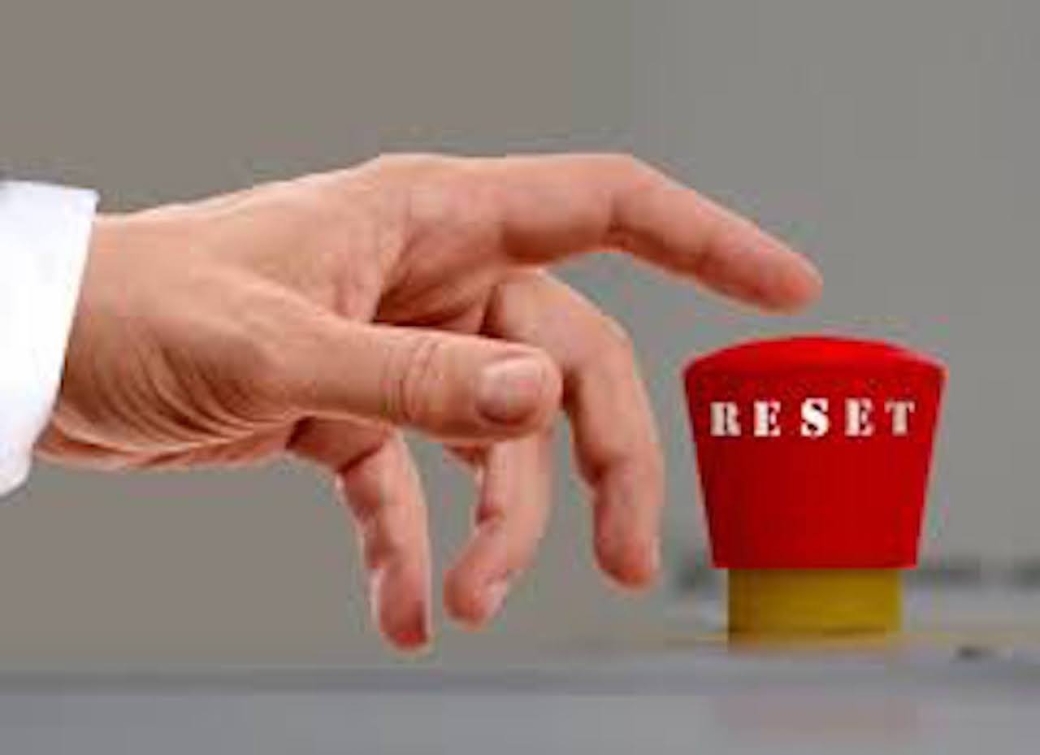
Resetting your collaboration
In Stuart’s , he identified some signs that a reset might be necessary. Let’s look now at what a reset might look like….
Having decided that something needs to be done, the typical response is to focus on structural, process and content issues. For example, the way we are set up, and the way people are working, especially the behaviours we see and don’t like, redesigning meetings or agendas, getting a better facilitator, managing the meeting dynamics better, calling out poor behaviour, etc.
While these might help, a much more useful approach is to focus first on the relationships. You might think of this like the Titanic and the iceberg - it’s what’s below the waterline that can sink the collaboration. And the relationship element is below the waterline; harder to see and trickier to deal with, but much more likely to allow smooth sailing when tackled.
Healthy collaborative relationships create a safer and more stable working platform in which to deal with current and emerging issues. So what can help reset the relationship and set you up for success in your collaboration?
- Acknowledging the history. Often there is baggage around what has happened before that impacts our behaviour, for example a past event that sticks in our mind and causes us to mistrust what others do. Surfacing some of that history and the consequences for each of us can help clean up the baggage. While this might be seen as opening old wounds, unacknowledged baggage can paralyse interactions, while respectful inquiry and acknowledgment in a safe environment can allow people to move on
- Checking and testing assumptions. Making visible our respective assumptions can be quite revealing, and allow us to test and explore the views we hold about others, and they about us. We can be quite surprised, and sometimes shocked (how could they believe that about us…..?), but we are then in a position test them and consider the implications for our work together. This can be quite cathartic, providing new insights and understanding of why people (us and them) may act the way we do.
- Putting yourself in the other’s shoes. This is where you try to see the world from the other person or group’s perspective. What really matters to them? What do they deeply care about? What makes them tick? What does their boss look for in their work? For example, one group might value social equity, and another may value technical expertise. If each perceives any situation only from their own perspective, misunderstandings and assumptions about motives might make it really challenging to find solutions together, leading to confusion and frustration. Taking time to hear how others think and work provides more shared understanding, facilitating more useful joint action on the difficult issues.
Sometimes clients are concerned that these activities will take time and distract from getting solutions. On the contrary, such reset activities can be a critical and essential investment in a robust working relationship, avoiding risks to solving key issues of structure, process and content. Is it time to reset your collaborative relationships?

Sure signs it is time to reset your collaboration
How to diagnose the health of your collaboration
When people are authentically and effectively collaborating, it’s an amazing thing to be a part of. But as we know, not all collaborative experiences are quite so positive. Sometimes it feels more painful than it needs to be. While we work hard at working together we continue to come up short on delivery of outcomes. We see argument when we want innovation and low commitment when we want buy-in.
If this feels like you, don’t despair. There are ways to reset and get your collaboration back on track. But first, how would you recognise that it’s time to reset your collaboration? In our experience, strong indicators include:
- unsatisfying delivery of outcomes
- people agreeing in meetings then disagreeing later
- a lack of face to face engagement. People reverting to email ‘wars’
- obvious friction in meetings, high stress, low morale
- lack of commitment to taking action
- people feeling left out and unappreciated in the relationship
- people pushing their own agendas and solutions
- not much listening
- information being hoarded and ‘weaponised’
Most organisations understand the need to work differently in collaborative partnerships and many start well. But there is growing evidence that a lack of understanding about what it takes to collaborate means many well-intended collaborative partnerships struggle over time. In such cases it can be useful to reset the relationship, to get the work and the teamwork back on track.
But a reset can’t happen overnight. It needs more than a workshop. In our next blogpost we will be outlining how to reset your collaboration and get back on track to deliver great outcomes together.
Meanwhile, if you need to reset your collaboration, to find out how we can help to get you back on track.